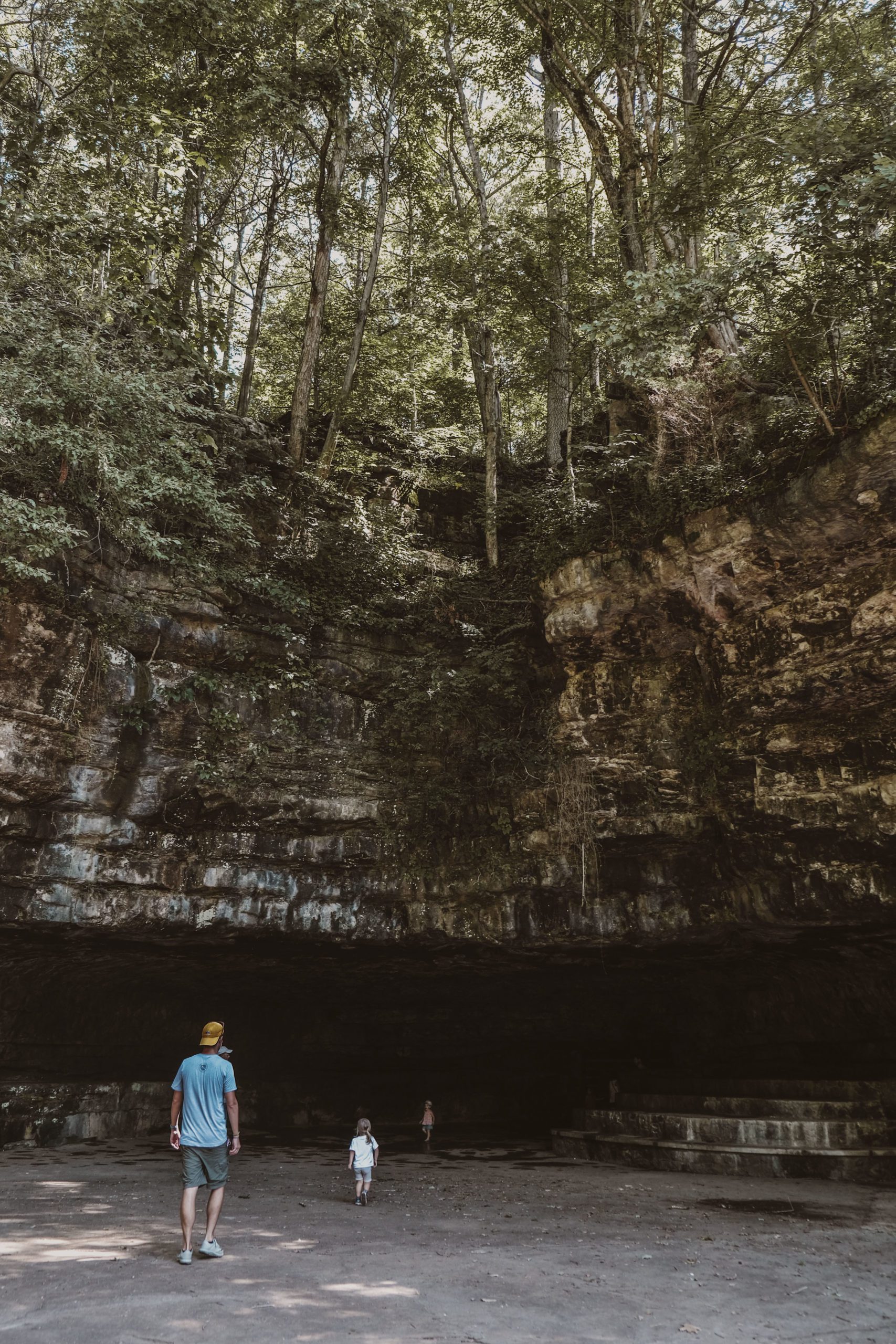
We visited Sycamore Shoals State Park as a side quest, and, in retrospect, our quick trip didn’t do the park justice. It was the middle of winter during the quiet season between Christmas and New Year’s. We had just spent three nights at the relatively nearby (and much larger) Roan Mountain State Park. A quick look at the Sycamore Shoals map shows a very small area along the Watauga River with not much more than a reconstructed 18th-century fort and a couple short walking trails. After visiting, that’s still an accurate snap judgment, but, like anywhere else, if you want the full story, you have to spend time going deeper.
The sky was dreary, and the light dusting of snow that’d hit the area the previous day was now being erased by spitting rain. The clock hadn’t yet reached 10:00 am, and we were the only people in the Sycamore Shoals parking lot leading directly to the Visitor Center and Museum. It’s essential to begin a trip here to understand why these 70 acres of land were important enough to designate as a state park. And for that, you have to take a complicated trip back in time, one that’s full of gray area between who are the heroes, the victors, and the victims of this story.

In the 1600s, and the previous 2,500 years – Indigenous villages inhabited Sycamore Shoals, this rocky area of rapids along the Watauga River.
By the late-1600s – the Cherokee had replaced the previous inhabitants and used the area as a meeting and trading place. But things really began to heat up in the mid-1700s as white settlers moved into the area. The official land of the colonies was getting crowded, and some people began pushing outside their borders. One of those people was the man who would come to be known as the “father of Tennessee,” James Robertson. He found a this fertile spot in the Watauga Valley (land that had already been cultivated by its previous Cherokee inhabitants, btw), staked his claim, and recruited a group of settlers to the area to form a regional government in 1772 that was totally independent from the colonies.
So, then things get more complicated. This rogue guy (Robertson) wants to create a government outside of British colonial authority. His settlers claimed they were on land that was part of the British domain, but a surveyor confirmed that it was actually Cherokee domain and that, to settle there, Robertson and his pals would have to lease the land from the Cherokee. It’s a shaky deal, as a Cherokee warrior has just been murdered by a settler, but goes through, and the Watauga Association is formed.
Then, a couple years later in 1775, the Transylvania Company, a land speculation company from North Carolina led by a guy named Richard Henderson, hears the Cherokee is selling land and wants to buy a lot of it in present-day Tennessee and Kentucky to form a “proprietary colony.” That’s an official-sounding name for something that is basically just a scheme where these “proprietors” are granted authority by the British Crown to privately settle and manage land for commercial means…meaning, to MAKE MONEY. The Sycamore Shoals Treaty (aka: the Transylvania Purchase) of 1775 signed about 20 million acres of Cherokee land to this company, totally splitting the Cherokee into factions that either wanted peace with settlers or wanted to protect their homelands, some even moving south and forming the Chickamauga.
Turns out, this deal was actually illegal, because colonial governors had to approve private land purchases from Native American tribes, and they had NOT approved this one. The people now living in this area were ordered multiple times to leave the area, but then the Revolutionary War broke out. The settlers sided with the colonies; the Cherokee, who had already gotten real sick of these settlers that were now supposed to leave, sided with the British. The settlers built Fort Watauga (then-called Fort Caswell) once the war began in 1775, anticipating the violence that would eventually erupt when the Cherokee attacked the settlement on July 21, 1776. The siege would go on to last about two weeks, and eventually the Cherokee retreated; the settlers had successfully defended their fort.
Later on in the war, the site was once again a hotbed of activity in 1780 as the Overmountain Men, a group of frontiersmen that fiercely fought the monarchy’s attempts to oust them from the westernmost settlements, gathered at Sycamore Shoals to begin their march to King’s Mountain in South Carolina. The Patriots, with the Overmountain Men, won a decisive victory over the loyalists that contributed to the outcome of the war.
There is further history to discover at two additional park properties: the Carter Mansion, constructed between 1775 and 1780, is the oldest frame house in the state and was the historic home of Landon Carter (namesake of Carter County) and his wife Elizabeth (after which the nearby town of Elizatbethon was named); the early 19th-century Sabine Hill, located west of the museum, is considered one of the finest examples of Federal-era architecture in the state. Beyond history, the park has a 1-mile walking trail that crosses the Watauga River (following the historic path of the Overmountain Men), a certified Arboretum, a butterfly garden, and river access for fishing, canoeing, and kayaking. Neither of these were open when we visited, though.


So ultimately, this small little blip on a map was actually home to the most American of stories: where the histories of indigenous tribes, frontiersmen, and colonial America intersect.
Sycamore Shoals became a state park in 1975 after the reconstructed fort was commissioned in the fervor leading up to the country’s bicentennial. I think this is important context, to remember when and why this location and its stories were found, preserved, and told. And things have changed a lot in the past 50 years. It’s a very “American” story that was certainly proudly told 50 years ago: The early settlers of the Watauga Association were driven by the opportunity of independence, an existence of self-governing autonomy, that led to their continued push west, building their territory into a large settlement that would eventually become the new state of Tennessee. But in the present, it was hard for me to experience the story without a great deal of conflict. It’s the same conflict one may feel in honoring many locations of significance in American history. How do we present the people involved? And should the retelling take a side? Now, in the year of American’s 250th anniversary, I think it’s how the story is told, and the voices included, that matter most.
Whereas many of the Tennessee State Parks do an excellent job of seeking and sharing the voices and stories that have historically been omitted or marginalized, I felt like the museum here lauded the experience of the fierce, courageous settlers above all else. It very much supported the myth of American independence, allowing this idealism that has crystallized our identity over the last 250 years to justify any actions taken to achieve the growth of this nation. I wish the narrative gave more consideration to the whole story, rather than celebrate one side of the story… and maybe, one day, it will.

CHECKLIST:
Date: December 2023
Count: 31 of 57
Region: East Tennessee
Must-See: Visit the museum to learn the history of the site