I had a good conversation the other day with a fellow middle school librarian about diversifying our reads. As I’ve acknowledged, I know a ton about children’s and young adult books, thanks to my profession. But I’m also just your average “grown-up.” When reading for pleasure, I most often read books intended for my adult level. And as I’ve tried to build this list of my recommended “adult” reading with Black characters, I’ve struggled.
This may be an entirely inaccurate or misguided critique of adult literature, but I find that adult books are so often written as just that – literature as opposed to stories. It’s like this added level of heft attributed to specific titles that have been marketed and promoted as diverse voices or experiences; they’re aiming for bestseller lists and book club picks instead of just storytelling. And whereas in middle school books, it’s incredibly easy to find everyday stories that feature Black characters, in adult books, you know you’re reading a story with Black characters about the Black experience, perhaps by a Black author, because the marketing (and word-of-mouth) has told you so.
To be clear, this isn’t a bad thing. I think there’s even more necessity in the world of adult literature (as opposed to children’s/YA) to specifically highlight Black voices and experiences, because it’s a field that has long been dominated by a white-centric perspective. (The YA genre, by contrast, is fairly young and has been less hindered by historical norms or standard operating procedures.)
But as I’ve attempted to build a list, I’ve struggled to find books that I have read (and can therefore recommend first-hand) that aren’t already well-known and well-read. I don’t need to recommend Americanah (by Chimamanda Ngozi Adichie), The Underground Railroad (by Colson Whitehead), or How to Be an Antiracist (by Ibram X. Kendi); if you’re bookish enough to be checking out this post for reading recs, chances are high you’ve already heard of or read those – and they’re rightly featured on a zillion lists already!
So because I think this current list is severely lacking, I’ve done two things:
- This will be a living list that I’ll update as I read new titles and hear new recommendations.
- I’m including non-fiction titles that share either stories of Black experience OR address the racial inequalities facing our society. I find both can make significant contribution to a person’s knowledge/schema and can provide some thoughtful steps for moving forward with action.
FICTION
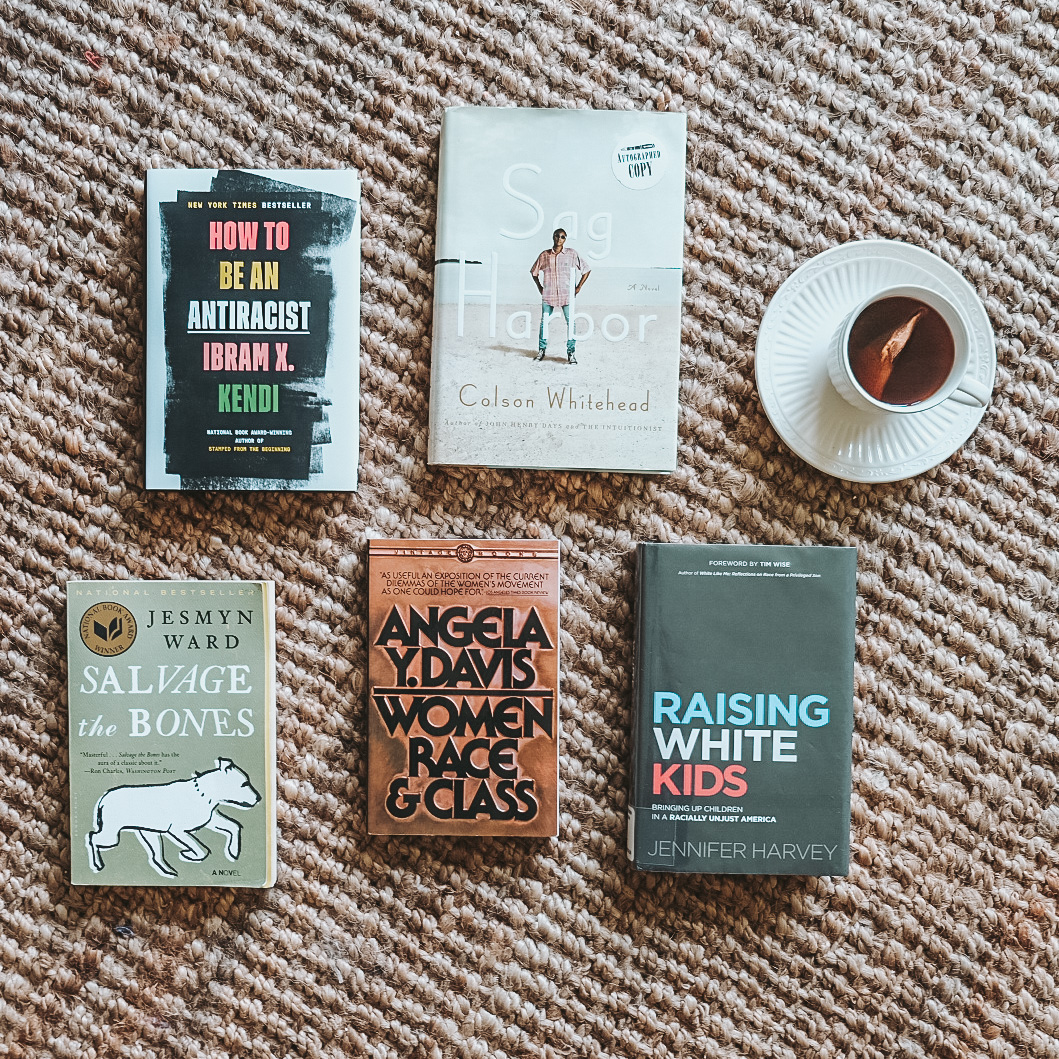
Sag Harbor by Colson Whitehead – Today in 2020, Colson Whitehead is SUPER well-known in the literary world. Sag Harbor is not his first novel (prior ones were even award-winning), but I remember distinctly the buzz it got in 2009 and how it seemed to launch him into a higher literary stratosphere. In it, the year is 1985 and 15-year-old Benji is spending the summer at the Sag Harbor beach, a nook of Long Island where affluent African-Americans have built their own beach community. It’s an environment that contrasts the one he lives during the school year as one of the only Black students at an Upper East Side prep school. It’s witty and descriptive with fantastic pop culture references; overall kind of plot-less but an entertaining portrait that is full of themes.
The Supremes at Earl’s All-You-Can-Eat by Edward Kelsey Moore – Follows three friends from their adolescent life in the 1960s to their middle-aged present. They’ve always lived in their same Indiana town with the one constant in their life being Earl’s diner, where you can find them in their same booth every Sunday for lunch. The characters are wonderful and so different from each other – and the author treats them equally, giving life to all three in vivid detail. Definitely character-driven rather than plot-driven; and I’m still majorly impressed this male author voiced three distinct women so well. Also, there’s a sequel: The Supremes Sing the Happy Heartache Blues
The Girl Who Fell From the Sky by Heidi W. Durrow – Rachel is a young half-Danish, half-African-American girl who moves to live with her strict African-American grandmother after surviving a tragedy that takes the rest of her family. As a 6th grader, she struggles to define herself when the rest of the world seems perfectly comfortable classifying her strictly by her race. The narrative voice shifts between participant and observer, combining stories of internal and external identity, and creating a thoughtful statement on the modern definition of “race.”
The Known World by Edward P. Jones – Henry Townsend has had his freedom since he was a boy; his free parents bought his freedom from his master who, atypically, took Henry under his wing, made sure he was educated, and treated him more like a son than property. As a result, Henry adopted this belief system as a slave-owning adult, causing conflict between his parents, his plantation, and the Virginian society directly outside his realm of reign. Because in this Virginia town, free blacks owning slaves contradicts how things “are supposed to be;” slavery becomes less about race and more about class, invalidating all the rules from slavery that put Blacks below whites and causing chaos as the rules of society and morality are called into question. You’ve got to focus reading this one, but it’s so satisfying to watch this world unfold.
NON-FICTION
Becoming by Michelle Obama – This book is already widely-known, I realize, but what I encourage you to read this for is her amazing ability to see the big picture and determine the small action steps needed to effect large-scale change. She chronicles how her experiences, and the subsequent knowledge she gained from those experiences, have shaped and guided her actions and work. And THAT, to me, is the inspiration and motivation to take away from her story.
Raising White Kids: Bringing Up Children in a Racially Unjust America by Jennifer Harvey – As a white parent of white children, I strive to create a racially conscious environment that will inspire in my children future actions towards racial justice and equality. I hear over and over the important directive to “talk to your kids about race” – but that’s so much easier said than done! What does that look like with a two-year-old? This book provides directions – immediate actionable steps – that can easily and immediately be implemented in daily life. It points out that which we take for granted in child development requiring us to be specific and explicit in our teaching, while also painting a big contextual picture that illustrates the “why” and “how we got here.” Definitely a much-needed useful resource and one I’d recommend to any frequent caregivers of white children (read: Mom and Dad, I’ll lend you a copy!)
Race, Women, and Class by Angela Davis – I actually haven’t read this; but Colin has, and he has referenced it NUMEROUS times in 3 years since doing so. He says: “This book casts a sharp eye at historians that wish to minimize the role of women – particularly Black women – in American culture. Angela Davis is a force and her energy impacts every sentence as she deconstructs American history from the first enslaved peoples through the suffrage movement to present day (at the time of publishing). She elucidates the moments when women, race, and class overlapped in communal goals and expounds upon the historical moments when those descriptors might have been at odds. It’s an enlightening, frustrating, and sobering read that is an important step towards understanding the world we live in today.”
Have Black Lives Ever Mattered? by Mumia Abu-Jamal – A series of essays on the seemingly never-ending wrongful deaths or convictions of Black Americans by racially-motivated violence, police brutality, or unjust legalities. The author has written these since his imprisonment in 1982, when he was convicted of killing a Philadelphia police officer. Abu-Jamal’s words are strong, angry, opinionated, and chilling; this is his manifesto against violence that’s proven to be inherent in the system. A powerful read, and especially important for those of us with white skin.
You Can’t Touch My Hair: And Other Things I Still Have to Explain by Phoebe Robinson – A humorous collection of essays from a comedian’s experience as a Black woman. I loved that it’s not just a self-indulgent collection of anecdotes; she’s writing with a purpose and intent to highlight moments, teach, and inform. Her writing’s strength is definitely in the use of examples and comparisons that make her point plainly and directly but in a warm and connecting way. Another similar collection of essays I’ve read: The Misadventures of Awkward Black Girl by Issa Rae.